


The Story I’m Making Up About You
What happens when perception shapes the way we see the people we work with?

We all have stories about the people we work with. She's controlling. He's difficult. She's too sensitive. He's disengaged. She questions everything. He never listens.
But how much of that is what we actually know about the person and how much is the story we've created about what their behaviour means?
Two people can sit in exactly the same meeting, hear exactly the same conversation and walk away with completely different versions of what happened. One person may think, “She was being controlling,” while the other walks away thinking, “I was simply trying to make sure we had a clear plan.” Someone may interpret a quiet colleague as uninterested, while that colleague believes they were listening carefully and taking time to process what was being discussed.
Neither person necessarily set out to misunderstand the other. They simply experienced the same behaviour from different perspectives. And perhaps that is where some of the most difficult misunderstandings in our teams begin.
“The story I’m making up…”
Brené Brown uses a phrase that has stayed with me: “the story I’m making up.” It invites us to recognise the difference between what we actually know and the meaning we have attached to an experience.
Think about something as ordinary as sending a colleague an email and receiving no response. What do we actually know? We know that they haven't replied. But very quickly, the story can become, “They're ignoring me,” or “Clearly this isn't important to them.”
Perhaps they are ignoring us. But perhaps they're dealing with a deadline, haven't seen the message, forgot to respond or are waiting until they have enough information to give us a proper answer. The facts haven't changed, but there may be several possible explanations for them.
The same thing happens in meetings. A colleague challenges an idea, and we interpret that challenge as disrespect. A manager asks for more detail, and we decide they don't trust us. Someone wants to make a decision quickly and we experience them as impatient, while someone else wants more time and we decide they're being difficult.
The behaviour is real. Our interpretation of what that behaviour means, however, isn't always the only possible interpretation.
When difference becomes a problem

The difficulty isn't that people are different. Teams need different people. We need people who move quickly and people who slow things down, people who challenge and people who stabilise, people who think aloud and people who need time to think. We need people who naturally focus on getting the task done, as well as those who instinctively consider the people affected by it.
The problem begins when we stop seeing those differences as differences and start interpreting them as faults. Someone who communicates directly can quickly be described as rude, while someone who is more careful and considered may be seen as slow. Enthusiasm can be mistaken for being unfocused, quietness for disengagement, questioning for negativity, and decisiveness for being controlling.
These interpretations can become powerful because once we have created a story about someone, we often begin looking at their behaviour through that story. The next time the direct colleague speaks plainly, we notice how “rude” they are. The next time the careful colleague asks another question, it confirms that they are “slow”.
Before long, we may no longer be responding only to the person in front of us. We are also responding to the perception we have built of them.
So perhaps there is another question worth asking: What might change if we could see that same behaviour from where they are standing?
What happens when we can actually see our differences?
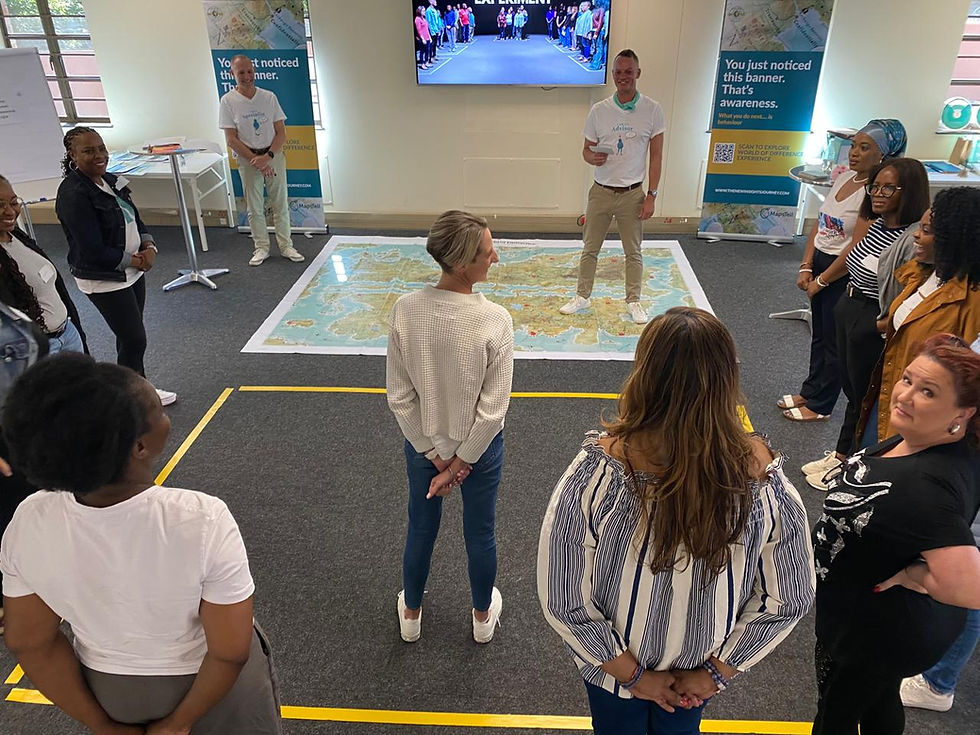
This is one of the things that fascinates me about behavioural mapping. We can talk about behavioural differences, communication styles and self-awareness, but something different happens when those concepts become visible.
Imagine standing on a large behavioural landscape and discovering where you naturally find yourself. You begin exploring some of your own behavioural tendencies — how you communicate, how you approach people, what may energise you, how you tend to respond and what can happen to your behaviour under pressure.
Then you look across the map and discover that your colleague isn't standing anywhere near you.
Suddenly, the difference between you isn't simply something being described on a page. You can see it.
That physical distance can open up an entirely different conversation. The colleague you've struggled to understand isn't necessarily trying to be difficult. They may simply be approaching the same situation from somewhere very different to you.

Instead of asking, “Why can't you just make a decision?” we might become curious enough to ask, “What information do you need before you're comfortable making this decision?” Instead of assuming that someone who continually asks questions is challenging us, we might ask, “What are you seeing that I might be missing?” Rather than deciding that a quiet colleague has nothing to contribute, we might discover that they prefer time to process before sharing their thoughts.
The difference was there before we stepped onto the map. The map didn't create it. It simply gave us another way of seeing it.
Understanding doesn't mean excusing behaviour
There is an important distinction here. Understanding why someone may behave in a particular way doesn't mean that every behaviour suddenly becomes acceptable. Disrespect is still disrespect. Poor communication can still cause damage. People remain accountable for the impact their behaviour has on others.
Behavioural understanding isn't about giving people an excuse. Instead, it gives us another question to ask before reaching a conclusion: Could there be another explanation for what I'm seeing?
That question introduces something incredibly valuable into a team: curiosity.
Instead of immediately deciding who is right and who is wrong, we create space to understand where the other person may be coming from. Sometimes our original conclusion may still be correct. But sometimes we discover that the intention behind the behaviour was very different from the meaning we attached to it.
And that discovery can completely change the conversation.
We don't need another box
Behavioural and personality tools can be incredibly useful, but they can also become limiting when we turn them into labels. A person becomes a colour, a collection of letters or a “type”, and before long the tool that was supposed to help us understand people can become another way of putting them into boxes.
For me, behavioural mapping should do almost the opposite.
A map should be the beginning of a conversation, not the end of one. It gives us a way to say, “This is where I seem to find myself. This may help explain why I communicate the way I do, why certain environments energise me, why some situations frustrate me and how my behaviour might change under pressure.”
But then comes the important part: Where are you?
That is where self-awareness starts becoming awareness of others. We stop using behavioural insight simply to explain ourselves and start using it to become curious about the people around us.
The purpose isn't to say, “Now I know what type of person you are.” It is to say, “Now that I understand myself a little better, perhaps I can understand you differently too.”
So, what story are you making up?

Think about someone you work with who occasionally frustrates you. Not necessarily the impossible colleague, just that person whose way of approaching things sometimes leaves you wondering, “Why do you do it like that?”
What story have you created about their behaviour?
Maybe they're difficult. Maybe they're controlling. Maybe they're too slow, too loud, too quiet, too emotional, too cautious or too demanding.
But now imagine, just for a moment, being able to stand where they're standing and see the situation from their perspective. Would you interpret their behaviour in exactly the same way?
Perhaps you would. Perhaps you wouldn't.
But even if nothing else changed, you might become a little more curious before deciding what their behaviour means. And that small shift can change a conversation, because understanding each other doesn't require us to become the same. It asks us to recognise that the person standing somewhere else may be seeing something that we simply can't see from where we are.
Maybe better communication doesn't always begin with learning how to speak.
Sometimes it begins with learning how to see.
See Your Team Differently
This thinking is at the heart of our upcoming public See Your Team Differently – A New Insights Behavioural Mapping Workshop, taking place on 28 October 2026 at Focus Rooms in Johannesburg.
This isn't a day spent sitting through slides or being told what “type” of person you are.
It is an interactive, hands-on experience where participants step onto the behavioural landscape and begin exploring what happens when we see ourselves and the people around us from another perspective.
Each participant receives their own personalised PersonalMap and Route Guide, in both printed and online format. During the workshop, we'll use the map to explore behavioural differences, communication, perception and the ways in which our own behaviour may be experienced by others.
The workshop is designed for employees, managers, team leaders, HR professionals and anyone who works alongside people who don't always think, communicate or respond in the same way they do.
Perhaps your team doesn't need everyone to think alike. Perhaps they need an opportunity to understand why they don't.
Reference: Brown, B. (2015). Rising Strong. Spiegel & Grau.
See your team differently. Step onto the map.
28 October 2026 | Focus Rooms, Johannesburg
Seats are limited.


Comments